




- July 23, 2025 - Biosphère
On Québec’s cultural landscape, there are few artists who embody the alliance between theatrical creation and environmental commitment with as much power as Christine Beaulieu. An actor, author and playwright, she’s succeeded in turning the stage into a true forum for civic reflection, where environmental issues come to life with remarkable intensity.
A memorable encounter
I was lucky enough to cross paths with Christine in 2015, during a visit to the Eastmain dam in the Nord-du-Québec region. At the time she was conducting research for her play J’aime Hydro, while I was working on Équiterre’s first electric-transportation campaign. In less than five minutes, something clicked between us. This was the start of a series of rich, stimulating collaborations.
I’ve been witness to her creative process, her rigorous research, and her many travels across Québec – often on board her electric car – to meet indigenous communities. An adventurer with a heart of gold.
A new collaboration at the Biosphère
And recently, as director of the Biosphère, I proposed to Christine that she present her play The Salmon of the Mitis River at our museum. She enthusiastically agreed. That collaboration was a natural fit: the Biosphère presents transformative scientific and artistic experiences whose aim is to reconnect people with nature and mobilize them for ecological transition.
Giving rivers a voice
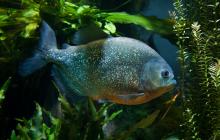
The Salmon of the Mitis River is a poetic and committed work that literally gives a voice to the wild salmon in the Mitis River affected by hydroelectric damming. The play demonstrates that energy transition is impossible if biodiversity is not protected. During one of our conversations, I wanted to learn more about her love for nature and her vision of theater as a lever for social transformation.
Isabelle St-Germain: Can documentary theater transform people? I’m thinking in particular of J’aime Hydro, which marked the collective consciousness of Quebecers.
Christine Beaulieu: The comment that touches me the most is when someone says to me: “Ever since J’aime Hydro, when I turn on the lights at home, I think of the river.” This connection between our comfort and a natural resource is fundamental. Living in the city can distance us from nature: it’s a normal thing to forget about nature because nothing reminds us of it in our day-to-day lives. Theater can awaken the imagination and raise our awareness in all sorts of ways.
With J’aime Hydro, people got back in touch with rivers. With The Salmon of the Mitis River I want them to develop empathy for another species than theirs, without expecting any personal benefit. Protecting a resource or a wild animal for what they are. Letting a river flow, not obstructing a salmon’s way. I’d like people to love and want to protect nature without it necessarily meeting a human need.
Theater is a magical place where anything is possible. In The Salmon of the Mitis River we slip into the skin of a salmon. We understand its life and its challenges, and we feel a sort of compassion for a species different from our own. If we transform an ecosystem, we’re upsetting the lives of tons of species that live in it. And the day we come to regret our actions, there’ll be no turning back. Actions pile up, they don’t fade away.
With this creation, I wanted to reach out to people, to break down theater’s fourth wall between actor and audience. Every performance becomes a community show, an opportunity for dialogue, an exchange. I let myself be destabilized, I remain open to whatever may happen: a child with something to say, a gust of wind, a spectator wanting to make his or her little contribution to the performance. Before the show I take a moment to greet everyone and welcome them by offering a small salmon egg – a consideration that allows people to feel involved in the event.
Isabelle St-Germain: What is your relationship with nature?
Christine Beaulieu: I’m always surprised to hear, “There’s us, and there’s nature.” For me, we are nature. We have to learn to reintegrate ourselves into it and better collaborate with it, like a sister or a best friend. We have to stop trying to control it, but instead give it as much freedom as possible to live.
Isabelle St-Germain: Could you share a memorable moment with nature?
Christine Beaulieu: Jumping into a lake, at any time of year, makes me feel alive. Going up a mountain, becoming one with it – not to dominate it but to meet it in all its powerfulness. Climbing a mountain is an activity that’s often free, and that becomes a memorable day that satisfies and nourishes us.
Christine Beaulieu reminds us that art can be a lever for social transformation. By blending emotion, rigor and commitment, she turns theater into a space where the environment lies at the heart of citizenship and culture. She proves that theater can also be a powerful tool for participatory democracy.
Don’t miss performances of the play The Salmon of the Mitis River, presented at the Biosphère from August 20 to 24, 2025.


