





- May 27, 2026 - Biosphère, Jardin botanique
Stéphanie Pellerin’s career can only be described as inspiring. Today she’s a specialist in wetlands, but there was never any indication she was headed for a career in science.
How do you become a seasoned scientist and a wetland specialist? Stéphanie Pellerin admits that she wasn’t really interested in science at all. “When I was younger I dreamed of being a police officer, but it didn’t work out,” says the biologist from the Jardin botanique and the Institut de recherche en biologie végétale. But one thing shaped her path: the conviction that we end up finding our way, even in the face of uncertainty.
Unlike some of her colleagues who knew early on they’d become biologists, she made her way to science only gradually. At university, still unsure what her passions might be, she first turned her attention to economics, until she realized it didn’t really suit her. “Numbers all day long, that wasn’t for me.” It was finally in biogeography, the science that studies the geographic distribution of flora and fauna, that she found her calling. She discovered ecology and hydrology, and undertook her first project on wetland conservation.
Ironically, when she was younger, Stéphanie Pellerin avoided these areas, being sensitive to mosquito bites. Her early career in the field as a biologist, in the Bas-Saint-Laurent region, was distinguished by record swarms of biting insects. “I said to myself, if I’m capable of surviving that, then I’m on the right track!”
Stéphanie Pellerin the explorer
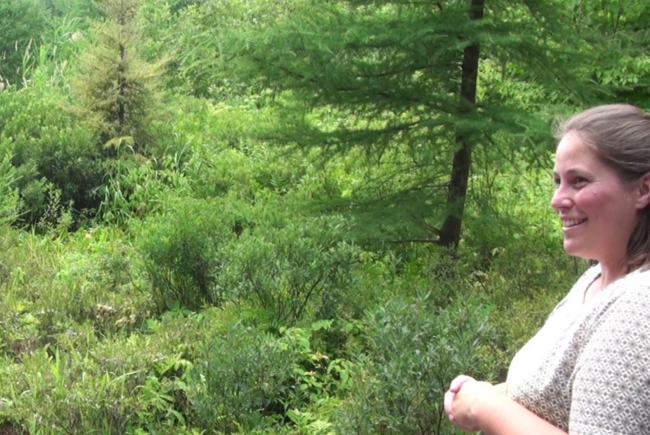
Walking through a wetland isn’t child’s play. “It’s messy, and you often get stuck in the mud,” she admits. But the biologist in her really enjoys it there. “What I like less about swamps, say, is the big spiderwebs between the trees. But otherwise, it’s a really pleasant environment.”
What’s the average day in the field like? Before even getting there, she and her team examine aerial images to identify areas for sampling. Once in place, she selects a number of representative sectors where she inventories the species observed and takes note of the different environmental data (water levels, soil moisture, sunlight exposure, and so on). These observations make it possible to evaluate the effectiveness of restoration work or to carry out a health assessment aimed at better protecting the wetland in question.
“The work is often demanding. The days are long, sometimes from six in the morning to six in the evening. So we have to make the best use of our time,” she explains. Demanding work, certainly, but work that offers unique moments. One of them she remembers is an unexpected encounter with a coyote: both of them froze for an instant before the animal ran off. She also mentions falling into a hole dug by the owner of a peat bog and hidden by vegetation. “He had a good laugh when I told him about my mishap,” she says, laughing herself. Occupations that hold this many surprises are few and far between!
The scent of wetlands
Did you know? Certain wetlands release very distinctive smells. According to biologist Stéphanie Pellerin, swamps can smell like decaying organic matter, something like the odor of damp earth after a rain shower. Peat bogs, on the other hand, can be recognized by their more sulfurous smell, reminiscent of rotten eggs.
Learn more about Stéphanie Pellerin's research projects.
Your turn to play!
Curious to learn more about science and maybe even discovering YOUR way?
Then don’t miss the Eurêka! Festival. In addition to an open house at the Biosphère, which is offering family-oriented exhibitions and activities, the festival is has a host of free experiences in store: over a hundred activities to help you better understand science, dozens of talks and interactive shows, more than 50 hands-on creative and experimental workshops – not to mention entertainment, challenges, surprising demonstrations and outdoor shows.