






- April 3, 2024 - Planétarium : Astronomical News, Experience
The total eclipse of the Sun on April 8, 2024, observable in southern Québec, is an opportunity to reflect on the rarity of these grand-scale phenomena. We’re lucky to be able to experience such an exceptional event: generally speaking, if you sit waiting patiently on your porch for the shadow of the Moon to pass over your head, the estimate is that you’d have to wait an average of…360 years between eclipses! Despite the fact that as little as 18 months can pass between two total eclipses at different places on Earth, in one specific location, the interval can easily reach several centuries, and for the less fortunate, even a few millennia.
The relative rarity of total eclipses
But solar eclipses aren’t that rare: at least two take place every year, sometimes three, and as many as four when they happen at the right moments on the calendar. But just roughly a third of solar eclipses are total, the others being partial or annular.
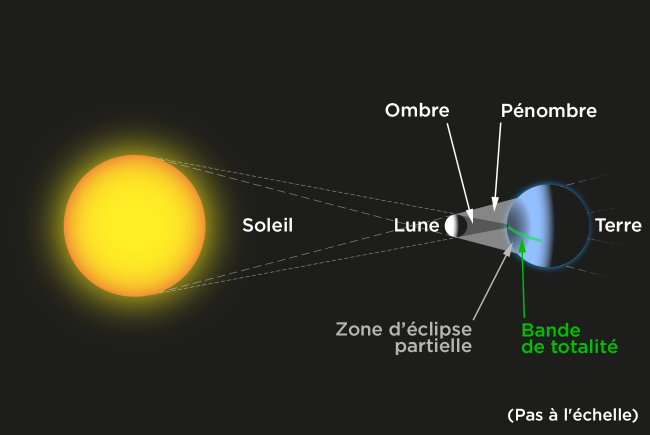
The relative rarity of total eclipses of the Sun is primarily the result of a terrible geographic injustice: they are truly total only along a narrow corridor on the planet’s surface: the well named path of totality. That path for the eclipse on April 8 stretches from the Pacific to the Atlantic over a distance of close to 15,000 kilometers, but at the most it’s only 200 kilometers wide. That represents a tiny fraction of the surface of the Earth, barely 0.5 percent in this case. On the other hand, in a huge area on each side of this ribbon of darkness, a partial eclipse of varying degrees will be observable. But elsewhere on Earth there will simply be no visible eclipse.
The path of totality may be imagined as a brushstroke that the Moon’s shadow draws on our planet. Its sinuous shape results from the movement of our natural satellite in its orbit and from the rotation of the Earth on its axis. The lunar shadow resembles a very, very long ice cream cone – a cone whose base, more or less circular, hugs the circumference of the Moon (3,475 kilometers in diameter) and ends in a point about 375,000 kilometers further out. Our “brush of darkness” materializes very close to that end point, where the cone is smallest. And that’s why the path of totality is so narrow.
Eclipse chasing – an extreme sport?
If the eclipse doesn’t turn up at our door, then it’s up to us to make the trip to the eclipse. Some people, it so happens, are ready to cross oceans and mountains to experience or re-experience the few minutes of magic that a total eclipse produces. Once reserved for a select few teams of professional astronomers on scientific missions, the democratization of travel has made eclipse hunting an activity accessible to growing numbers of people. And what do they have in common? A desire to repeat the fabulous experience of totality and to enjoy the emotions it provokes once again.
When we examine the trajectory of eclipses on a map of the world, we notice that very few of them reach densely populated areas that are easy to access or equipped with excellent transportation networks. Mostly they affect remote, even inhospitable places: distant oceans, impenetrable forests, polar and desert regions… Not counting conflict zones that are inaccessible for that reason.
We also have to consider climatological data for regions located along the path of totality. It’s impossible to predict the weather years, or even months, in advance, but some locations are statistically more favorable than others, even though a cloudless sky is never guaranteed.
Rendezvous with the lunar shadow
On the ground, on water or even up in the air, everywhere’s the right place for a rendezvous with the Moon’s shadow. But getting there can sometimes be logistically difficult and expensive, with some destinations being reachable only at astronomical expense. Not all eclipse hunters have unlimited budgets…
But setting foot in the Antarctic, bivouacking in the middle of the Sahara or traveling to exotic islands at the ends of the Earth remain unforgettable experiences painted with moving human encounters: as unforgettable as, if not more so than, the eclipse that prompted our choice of these distant lands. Because a total eclipse of the Sun is just a pretext for a trip that takes us off the beaten path, to meet others and ourselves.
So watch out if you catch the eclipse bug on April 8: it might take you far, far away from your porch!